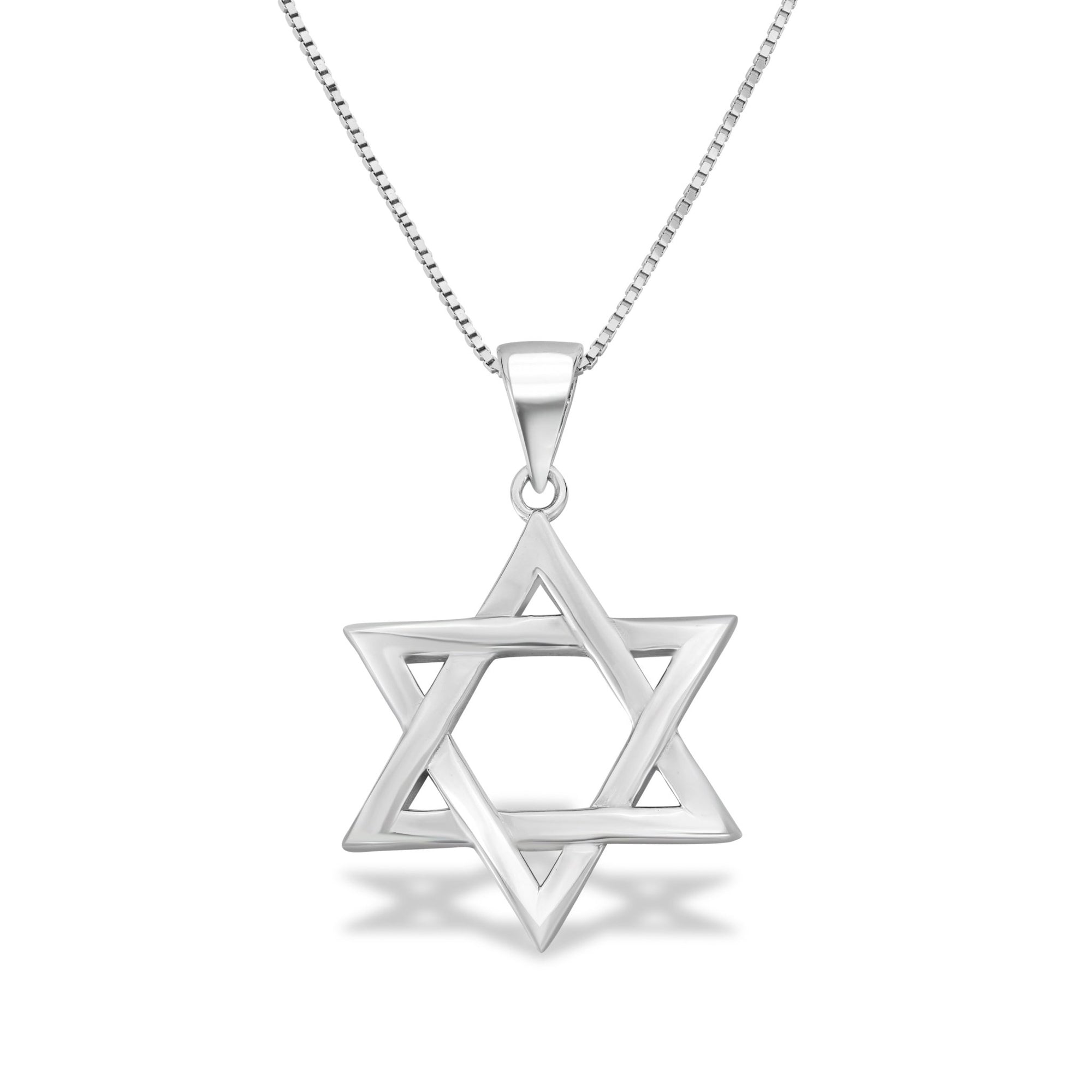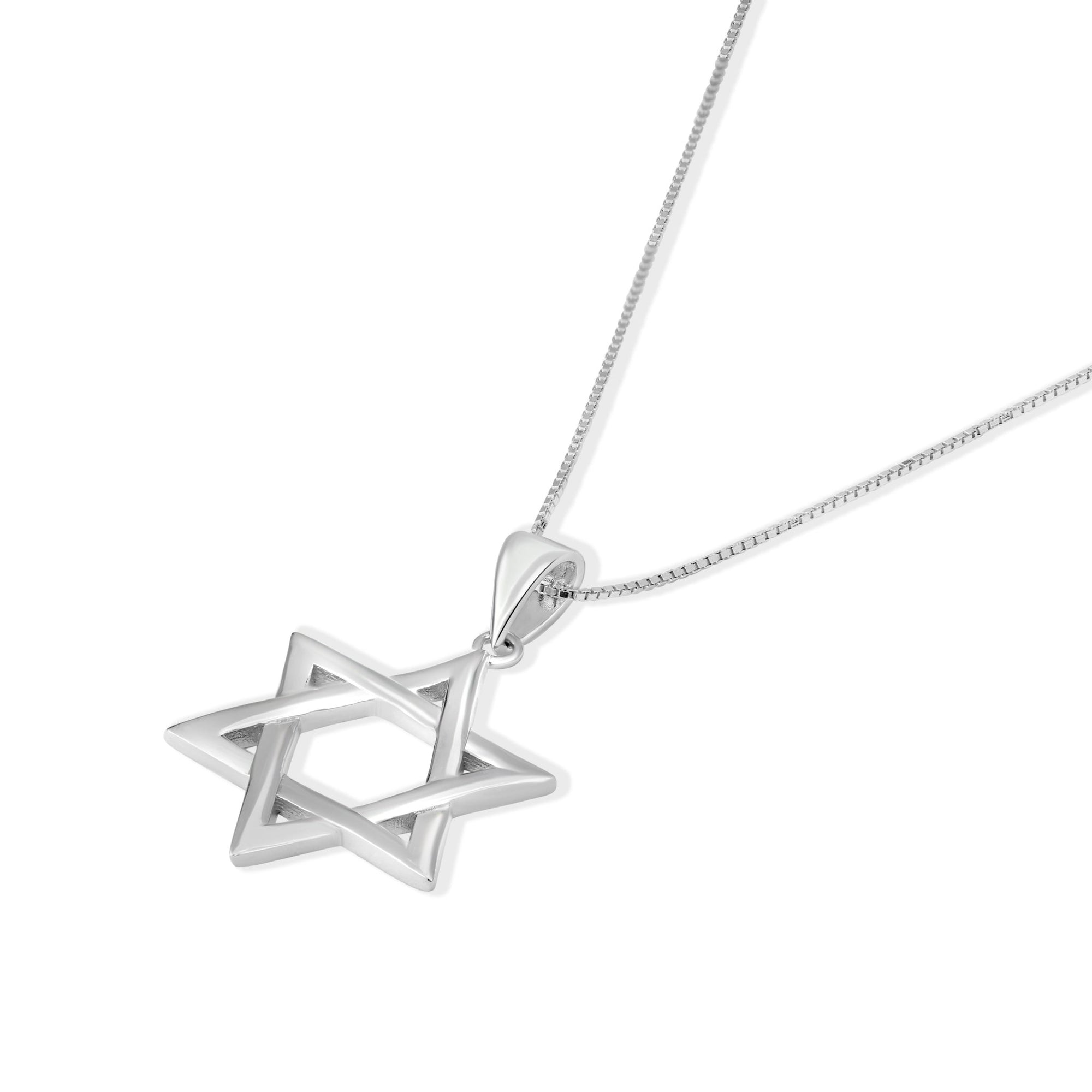


Short answer: A Star of David necklace carries the Magen David ("Shield of David"), a six-pointed star formed by two interlocking equilateral triangles that is the most widely recognized emblem of Judaism and the Jewish people, and the centerpiece of Israel's flag (Britannica). There is no single official meaning: popular interpretations read the six points as God's presence in every direction (north, south, east, west, above, and below), and the two triangles as the union of the spiritual and the material, heaven reaching down and earth reaching up. Worn today, it functions above all as a proud, protective marker of Jewish identity and connection to Israel rather than a symbol commanded by the Bible or Talmud.
What the six points and two triangles are said to mean
The Magen David is a hexagram: two overlapping equilateral triangles that form a six-pointed star with a hexagon at its center. "Magen David" translates literally as "Shield of David." Several beautiful readings have grown up around the shape, and it helps to treat them as meaningful traditions rather than one fixed doctrine, because the symbol has no biblical or Talmudic definition (My Jewish Learning).
The most common interpretation reads the six outer points as God's rule and presence in all directions, north, south, east, west, above, and below, a way of saying the divine is everywhere. A widely cited Kabbalistic reading treats the upward triangle as human aspiration reaching toward God and the downward triangle as the divine descending into the material world, so the interlocking star signifies harmony between heaven and earth. A related tradition maps the three sides of each triangle to God, the Torah, and the People of Israel. In a more detailed Kabbalistic scheme, the six points plus the center are counted as seven compartments corresponding to seven divine attributes (the sefirot: Chesed, Gevurah, Tiferet, Netzach, Hod, Yesod, and Malchut). These are interpretive layers offered by Jewish and Kabbalistic commentary, not a single decreed meaning (My Jewish Learning).
Where the symbol actually comes from
Two important caveats keep the story straight. First, the hexagram is ancient and was used across many cultures long before it was distinctively Jewish. It appears as a decorative carving at the ancient synagogue of Capernaum near the Sea of Galilee in the 2nd to 3rd century CE, but scholars regard those early examples as ornamental, not yet a recognized Jewish emblem (Unpacked). Second, the link to King David's literal battle shield is a cherished medieval legend rather than documented history; the name "Shield of David" reflects that tradition, and it grew out of 13th- and 14th-century Kabbalistic writings in Spain (Unpacked).
The symbol's rise as the definitive Jewish sign is a later development. In 1354, Holy Roman Emperor Charles IV granted the Jews of Prague the right to bear their own flag, and they chose a six-pointed star, the first documented official use by a Jewish community. By the 17th century it served as the seal of many Jewish communities and marked synagogues as Jewish houses of worship, much as the cross identified churches, still without any biblical mandate. In 1897, the First Zionist Congress in Basel, chaired by Theodor Herzl, adopted the Star of David as the emblem of the Zionist movement, and in 1948 the new State of Israel placed a blue star between two stripes on its national flag (Unpacked).
Identity, endurance, and pride
The star also carries the weight of Jewish history. During the Nazi era it was turned into a tool of persecution: a November 1939 decree required Jews over age 10 in occupied Poland to wear a white armband bearing a blue Star of David, and a September 1941 decree required Jews aged 6 and over across the Reich to wear a yellow star inscribed with the word "Jew" (United States Holocaust Memorial Museum). After the Holocaust, the community reclaimed the same symbol as an emblem of endurance and pride. That is a large part of why wearing one today can feel like a quiet act of continuity.
Wearing the Star of David
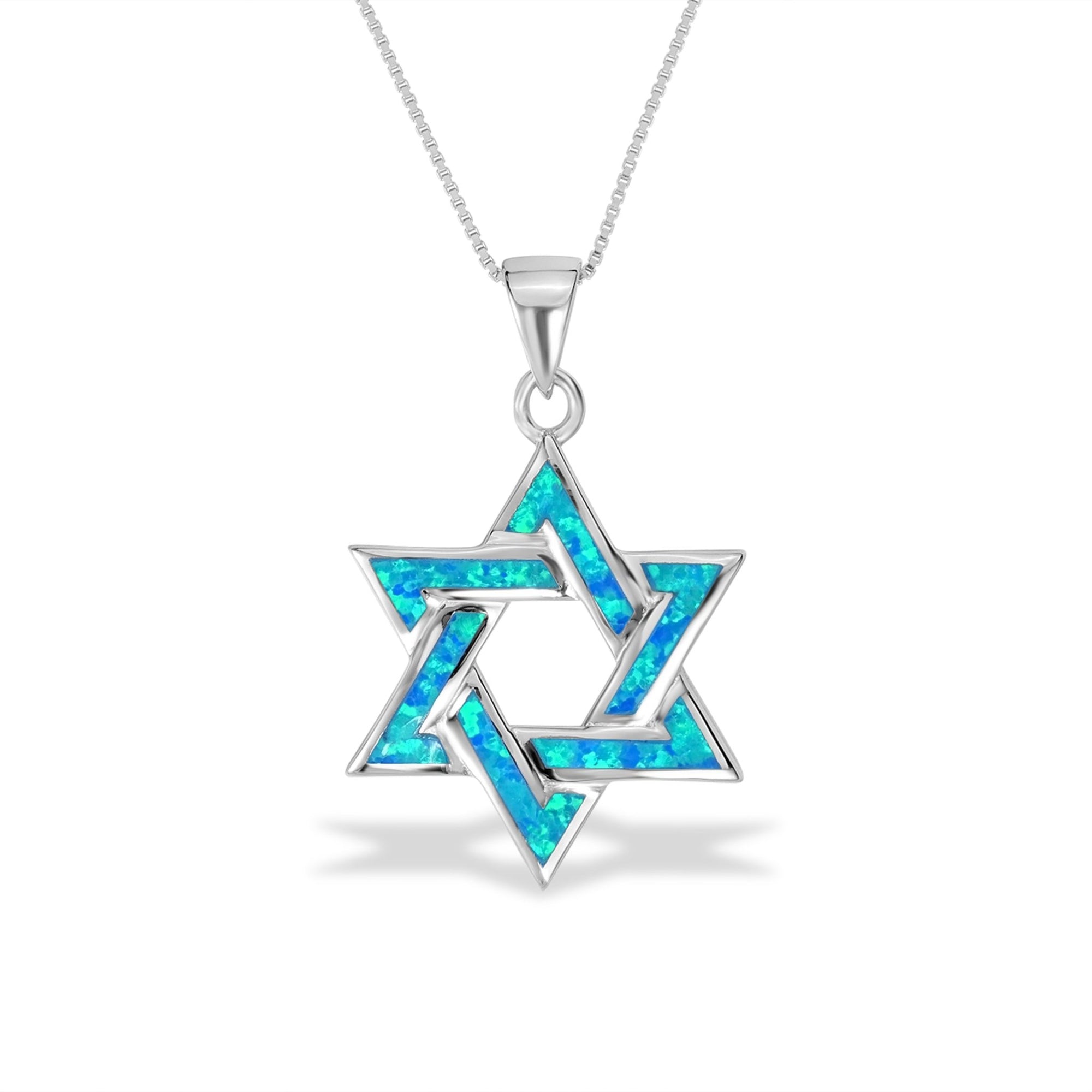
Because the meanings are layered rather than fixed, a Star of David pendant lets you carry whichever reading speaks to you: faith in a God who is everywhere, the meeting of heaven and earth, or simple solidarity with the Jewish people and Israel. Our Star of David jewelry collection gathers pieces in that spirit, from a classic Shalom Star of David necklace to opal pendants and rings, so you can choose the design that fits how you want to wear the symbol every day.
Bridge: Looking for a meaningful gift or a piece to call your own? Browse the Star of David jewelry collection at Shop Israel.
Related
- The meaning of the Star of David
- Star of David jewelry: designing with deep symbolism
- 6 symbolic meanings of the Star of David in contemporary jewelry
Last updated July 2026.