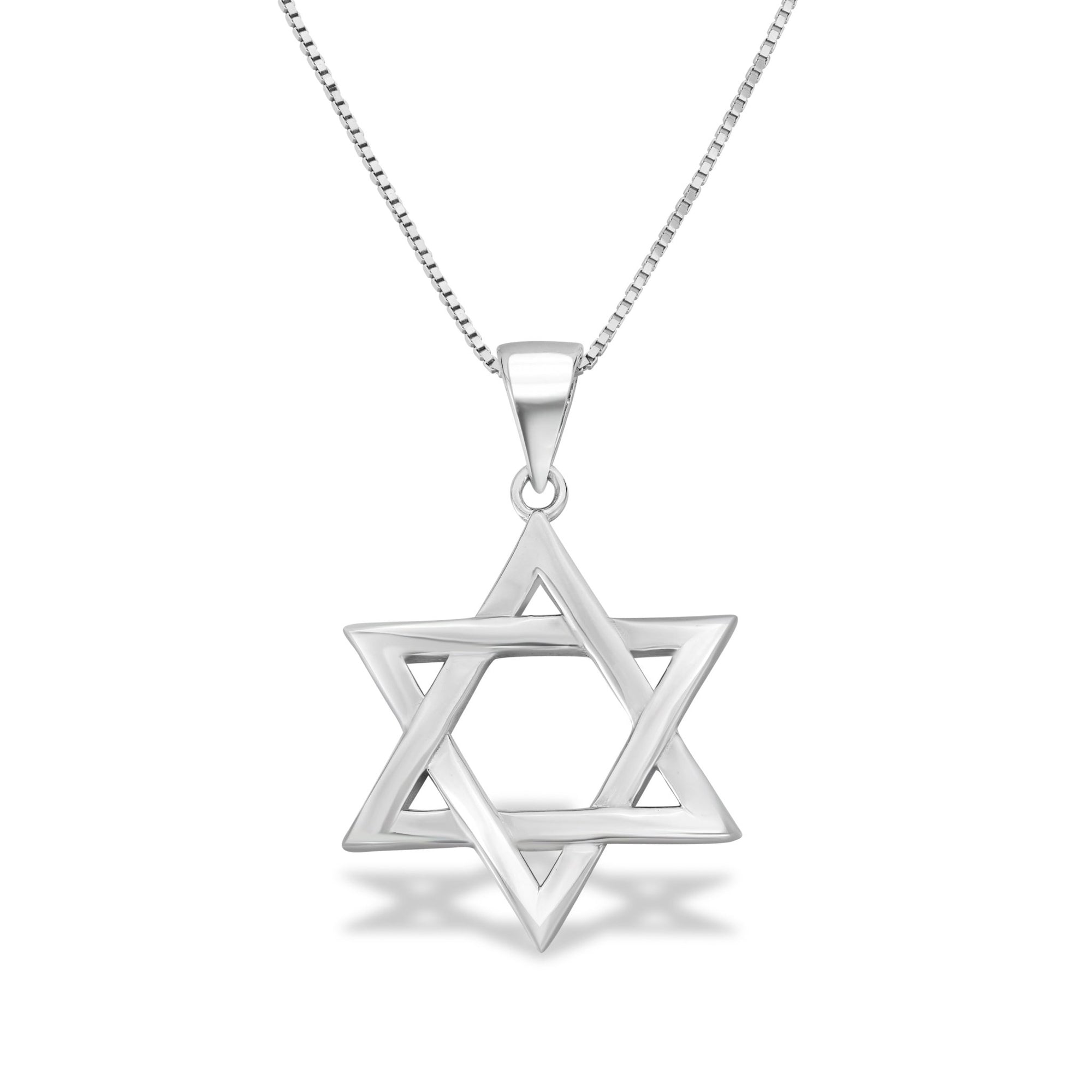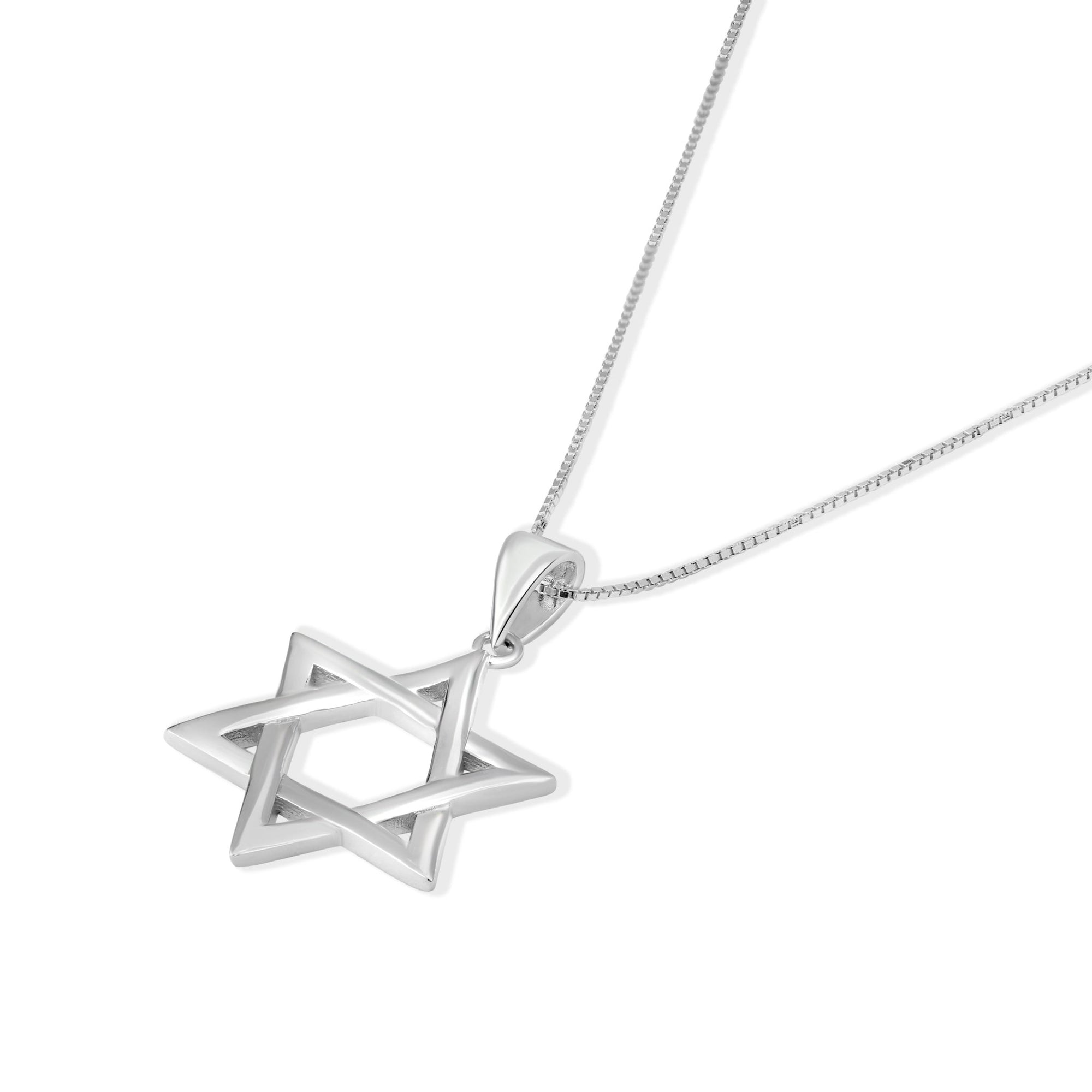


Short answer: The Star of David, in Hebrew Magen David ("Shield of David"), is a six-pointed star formed by two interlocking equilateral triangles, and it is today the most widely recognized symbol of Judaism and the Jewish people. In jewelry and artwork it carries layered meaning: divine protection, the union of heaven and earth, and Jewish peoplehood and pride. Its history is younger than many assume, growing from medieval Prague and Kabbalah, the 1897 Zionist movement, and Israel's 1948 flag, rather than descending directly from the biblical King David.
What the Star of David means
The symbol is built from two overlapping equilateral triangles that form a hexagram, a shape simple enough that it appeared across many ancient cultures as ornament or a magical sign (Wikipedia). What made it Jewish was accumulated meaning over centuries, not its geometry. Several readings recur in Jewish tradition, and all of them are fair to celebrate in jewelry and art. One is the union of opposites: the upward triangle standing for fire or heaven, the downward triangle for water or earth, joined into a single whole. Another is God's rule reaching in all directions across the world. A third, and perhaps the most beloved today, is the unity of the Jewish people across a diverse diaspora.
The Hebrew name Magen David, "Shield of David," reflects a religious tradition in which God, not any physical emblem, is King David's protector (Jewish Virtual Library). That sense of divine protection is a large part of why the star has been worn close to the body for centuries, and why it still reads as a small, personal act of faith.
The surprising history of the Magen David
As a marker of Jewish identity, the star is younger than most people expect. The oldest undisputed hexagram in a Jewish-linked context is a seal from Sidon that belonged to Joshua ben Asayahu, dated to the seventh century BCE, evidence that the shape circulated in the ancient Near East long before it meant anything specifically Jewish (Jewish Virtual Library). Centuries later, in the third and fourth centuries CE, a hexagram was carved as a decorative motif in Galilee synagogues, including a frieze at Capernaum where it sits beside a pentagram and other ornaments. Scholars read these early uses as decoration, not as an identity symbol (Wikipedia).
The turn toward meaning came from Kabbalah. In the thirteenth and fourteenth centuries, Jewish mystics attached the name Magen David to the six-pointed star and used it on amulets and mezuzahs as a sign of divine protection against harm, a history documented by the scholar Gershom Scholem (Commentary). Its first official communal use followed soon after. In 1354, Holy Roman Emperor Charles IV granted the Jews of Prague the right to bear a red flag displaying the Star of David, the earliest time the symbol served as a community's official emblem (New World Encyclopedia; Kafkadesk). From Prague the emblem spread across central Europe, marking Jewish quarters and appearing in synagogue architecture by the seventeenth century (My Jewish Learning).
Its leap to a universal Jewish symbol came with modern nationalism. In 1897, the First Zionist Congress in Basel placed the Star of David at the center of the movement's flag, and in 1948 Israel's Provisional Council of State adopted that white banner with two blue stripes and a central star as the flag of the new state (Jewish Virtual Library). Between those two dates lies the darkest chapter: from 1939 to 1945, the Nazis forced Jews to wear a yellow Star of David badge as a mark of degradation, a symbol Jews later reclaimed with pride (My Jewish Learning).
Wearing the Star of David today
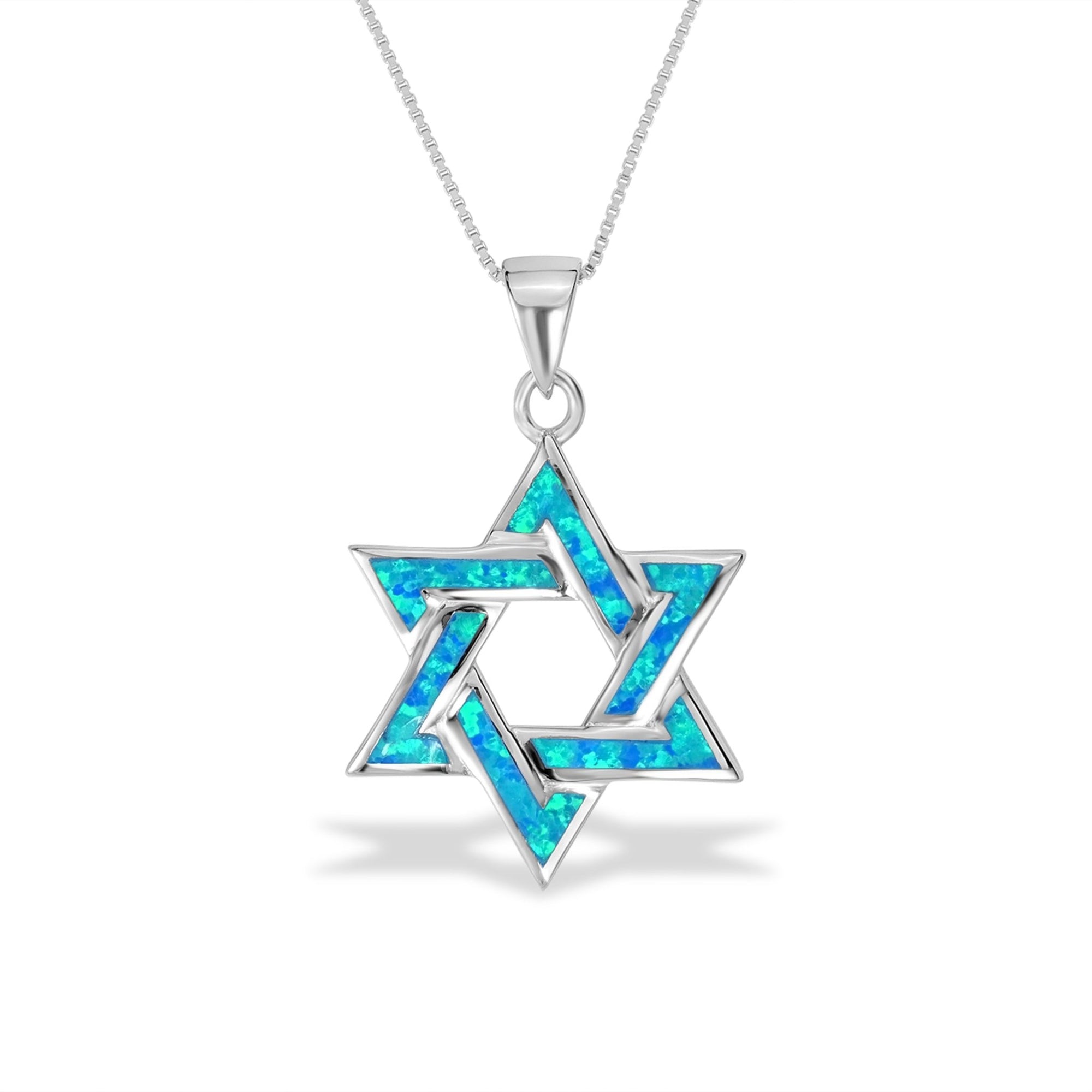
Because it carries so much at once, faith, heritage, protection, and belonging, the Magen David remains one of the most cherished motifs in Jewish jewelry. It reaches well beyond ornament, sitting at the heart of institutions such as Magen David Adom, Israel's national emergency medical service. Worn as a pendant, a ring, or a charm, it lets you carry that layered meaning close, and since October 2023 many people also wear it as a quiet, visible act of solidarity.
If you are looking for a piece that speaks to that heritage, our Star of David jewelry collection gathers pendants, rings, and charms in classic and modern designs, from the Eternal Star of David Ring to delicate necklaces made to be worn every day. Each one lets you keep centuries of meaning, protection, unity, and pride, right where you can feel it.
Related
- Star of David Meaning
- Star of David Jewelry: Designing With Deep Symbolism
- Top Jewish Symbols and Their Meaning
Last updated July 2026.